





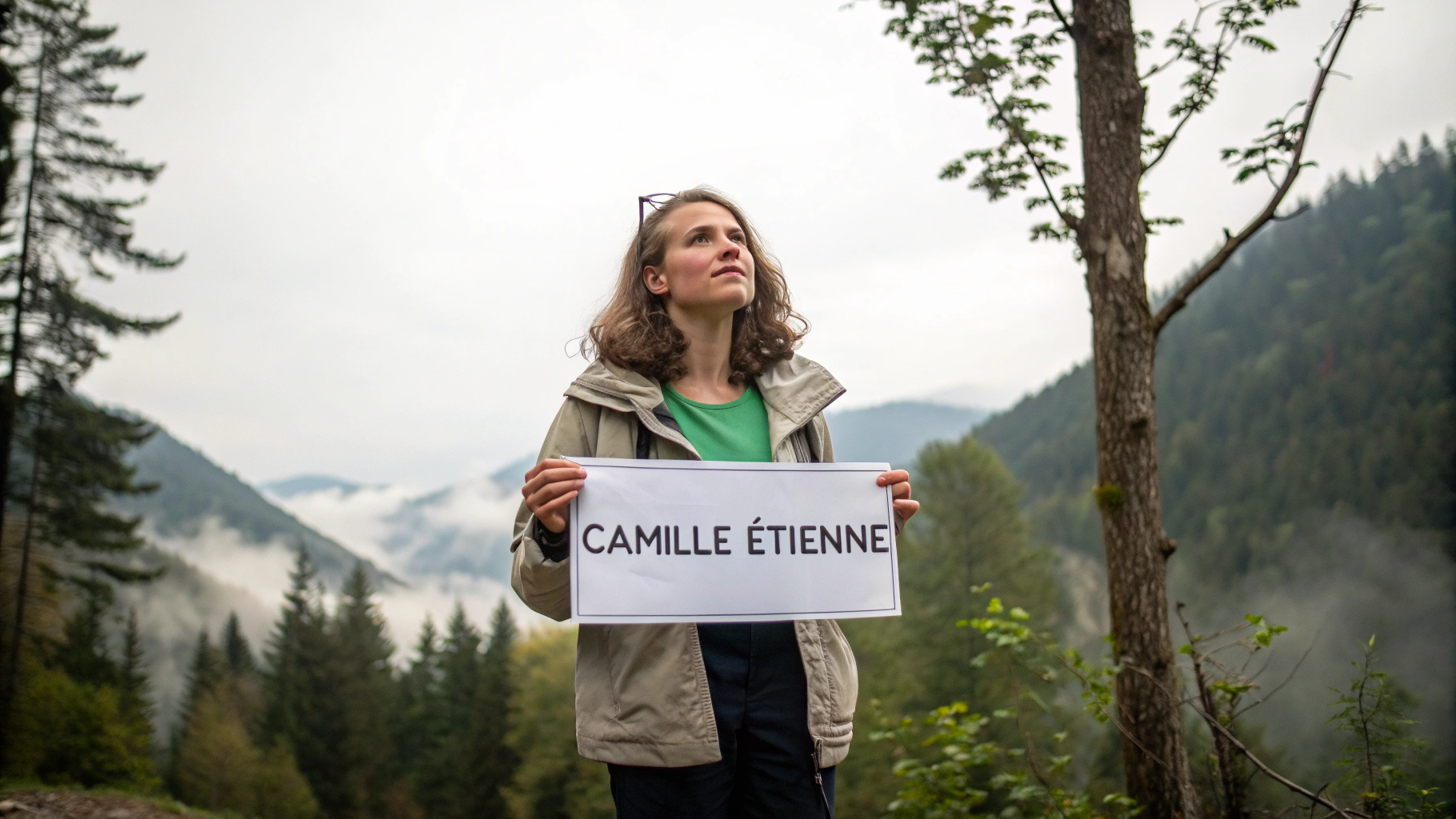
Camille Étienne is a young French environmental activist who speaks powerfully for climate justice.
She combines art, political action, and civil disobedience to raise awareness and push for real change. Born in the mountains, she grew up watching nature change and decided to dedicate her life to protecting it.
Over a few years, she has become one of the most influential voices in climate activism in France and beyond.
Who Is Camille Étienne?
Camille Étienne was born on May 29, 1998, in Grenoble, in the French Alps. She grew up in a small mountain village called Peisey-Nancroix, in Savoie. Her father worked as a mountain guide, and her mother used to be a top-level snowboarder and climber. Growing up surrounded by mountains made Camille very aware early on of nature’s beauty—and its fragility.
From childhood, she was sensitive to social injustice. At school she did very well: she got excellent grades in high school, especially in subjects linked to the mountain environment. Camille once dreamed of becoming a judge in family law, but as she grew older, her focus shifted toward climate issues.
She studied at Sciences Po (a top university in Paris), where she earned a master’s degree in economics. During her time there, she took a “gap year” (a break) to focus on activism full time.
Her Path into Activism
Camille’s activism began to take shape during her university years. While at Sciences Po, she joined the student branch of Amnesty International and even became its president. She also was part of a student group called NOVA.
In 2018, she became a spokesperson for a youth collective called On est prêt (meaning “We Are Ready”). With that group, she spoke at the European Parliament, alongside well-known climate activists like Greta Thunberg and others.
During the first COVID-19 lockdown, Camille co-founded a collective named Avant l’orage (“Before the Storm”) together with Solal Moisan. This project brings together art and environmentalism: dance, video, music, and activism all meet.
One of their first works was a video called “Réveillons-nous” (“Wake Up”), released on YouTube in May 2020. The film, shot in the mountains, features Camille speaking about the climate emergency while a dancer moves around her. That video struck a chord: it went viral and has been watched millions of times across platforms.
What She Fights For
Camille Étienne fights for environmental justice. She believes that ecological issues are not just about nature but deeply tied to social justice.She often says that a real ecological movement must also be a human and social one. Her fight is not only to save nature but to push for a fairer world.
One of her key campaigns is anti deep‑sea mining. She warns that mining the deep ocean floors is extremely dangerous for marine ecosystems. She started a movement called “Look Down” specifically to protest against deep-sea mining.
She is also very critical of the fossil fuel industry. For example, she is part of the Stop EACOP initiative, opposing the East Africa Crude Oil Pipeline, a huge oil project. Camille is convinced that these big industrial projects are not sustainable and threaten both the climate and communities.
Beyond that, she works on “forever chemicals” (PFAS), very harmful substances that pollute water and nature. She co-created a documentary about how these chemicals poison people and ecosystems.
How Does She Uses Art to Speak Up?
What makes Camille’s activism special is how she merges art and ecological messages. Through her collective Avant l’orage, she works with dancers, musicians, filmmakers. She believes art is a powerful way to touch people’s hearts and make them think differently.
Some of her films include GENERATION, DESOBEIR, and GLACIER. These works are not just about showing damage — they are invitations to reflect on our relationship with nature. For example, in GLACIER, she talks about glaciers melting, a deeply personal issue for her because she saw the mountains change while growing up.
She also writes: in 2023, she published a book titled “Pour un soulèvement écologique: dépasser notre impuissance collective” (“For an Ecological Uprising: Overcoming Our Collective Powerlessness”). In her book, she explores how people feel overwhelmed by climate change — and why acting together is the way forward.
Her Political Actions
Camille’s activism is not only symbolic — she pushes for real political change. She lobbies decision-makers, she supports legal actions, and she encourages civil disobedience when needed.
In 2021, she and other activists filed a complaint against several French government ministers for their inaction on climate. She uses the law to hold leaders accountable, believing that legal pressure can force political will.
She has also taken part in protests. For example, she joined a demonstration near the Élysée Palace (the French president’s residence) along with other well-known environmental figures. Camille’s point is that political systems must be pushed — not just asked — to act.
On the international front, she also engages at major climate summits and in negotiations. Her activism carries both grassroots energy and institutional leverage.
Her Influence and Recognition
Camille Étienne has won attention, both in France and internationally. When she was quite young, she was named one of Vanity Fair’s “50 French Women Who Made 2020.” She has also been recognized by other media as one of the most influential eco‑activists in her generation.
Her voice is known beyond France: she speaks publicly, does interviews, and is present in environmental networks.
Academically, she continues to grow: she has been associated with the Blavatnik School of Government (Oxford), where she further develops her work in public policy, combining her activist experience with rigorous study.
Her Personal Connection to Nature
Camille’s life in the mountains deeply shaped her worldview. She has said she saw how the Mont Pourri (a mountain near where she grew up) was changing because of climate warming. This direct contact with the natural world made her understand the stakes in a visceral way.
She often talks about “eco‑anxiety” — the deep worry many people feel about climate change. But for her, this worry is not a weakness. It is a healthy response to a sick world.
Challenges and Risks
Camille Étienne’s activism is not without risk or criticism. Civil disobedience and strong political action draw pushback. Some people question whether art is enough, or whether legal and political tools are effective.
She also acknowledges the emotional toll. Climate change is not just technical; it is moral, psychological, and deeply personal. Many of her speeches and her book touch on the feeling of helplessness — but she insists that collective action is the way out.
Balancing optimism and realism is central to her approach: she doesn’t promise that everything will be easy, but she argues that giving up is not an option.
Why She Matters?
Camille Étienne is important because she represents a new wave of climate activists: young, intelligent, driven, and creative. She doesn’t just shout; she builds bridges between art, law, political systems, and communities.
Her work reminds us that climate change is not just about CO₂ emissions or temperature charts. It’s about justice, power, and the kind of world we want to live in. By highlighting the connections between environmental harm and social inequality, she asks deeper questions: Who suffers most from climate change? Who profits? Who has a voice?
Camille also shows that change requires different kinds of strategies. Sometimes you lobby, sometimes you protest, sometimes you tell stories. Her mix of art and activism inspires people who might feel disempowered to become part of the movement.
Conclusion
Camille Étienne is a powerful and inspiring figure in modern climate activism. Born in the Alps and raised close to nature, she turned her deep love for the environment into a mission. Through her collective Avant l’orage, her films, her political work, and her writing, she brings people together and challenges us to rethink how we live and how we protect our planet.
Her message is urgent but hopeful: yes, the ecological crisis is massive, but collective, creative action can make a difference. She calls for a new kind of uprising — one rooted not only in anger, but in empathy, solidarity, and art.
Camille’s journey shows that young people do not have to wait to speak up. And she proves that activism can be both passionate and disciplined, visionary and grounded in real politics. Her work is a reminder: protecting the planet is not a job for a few — it’s a responsibility for all of us.
FAQs
1. Who is Camille Étienne?
Camille Étienne is a French environmental activist, born in 1998. She fights for climate justice and ecological transformation, using both political pressure and artistic action.
2. What inspired her to become an activist?
Growing up in the French Alps, Camille saw glaciers and mountains change because of climate warming. Her early sensitivity to injustice and her mountain upbringing deeply shaped her commitment to nature and justice.
3. What is “Avant l’orage”?
Avant l’orage (“Before the Storm”) is a collective that Camille co-founded. It links art and environmentalism — she works with dancers, filmmakers, musicians to create powerful climate-related pieces.
4. What was the “Réveillons-nous” video?
It is a video released in May 2020, during lockdown. Camille speaks about climate urgency in the mountains, while a dancer performs. The video became very popular, helping her reach a wider audience.
5. What causes does she campaign for?
She campaigns against deep‑sea mining (“Look Down” movement), fights fossil fuel projects (like the EACOP pipeline), and works on banning harmful “forever chemicals” (PFAS).
6. Has she written any books?
Yes. In 2023, she published Pour un soulèvement écologique: dépasser notre impuissance collective (“For an Ecological Uprising: Overcoming Our Collective Powerlessness”), where she talks about how to act together on climate.
7. Is she involved in politics?
Yes. She lobbies political decision-makers, supports legal action (for example, filing complaints against government ministers), and encourages civil disobedience to force climate action.
8. What recognition has she received?
She was named by Vanity Fair as one of the “50 French Women Who Made 2020.” She also works with top academic institutions like Oxford’s Blavatnik School of Government.
9. What is her view on climate anxiety?
Camille believes that feeling anxious about climate change (eco‑anxiety) is not a weakness. She sees it as a normal, even healthy, emotional response when the world is under stress — and a motivation to act.
10. Why does she link art with activism?
She thinks art can touch people’s hearts in ways that pure activism cannot. By combining dance, film, storytelling, and protest, she makes climate issues more accessible, emotional, and urgent.

Leave a Reply